
If you really want to understand Japan, skip the white tablecloths for a night and follow your nose instead. The best eating happens at street level — under paper lanterns, in narrow lanes thick with grill smoke, and in covered markets where vendors have been perfecting one dish for generations. Here’s where to go and what to put in your hand.
Start in the markets
Japan’s covered markets are the daytime heartbeat of street food, and each city has its own.
In Kyoto, Nishiki Market is known as “Kyoto’s Kitchen” for good reason. It’s a narrow, five-block arcade packed with stalls selling pickles, fresh tofu doughnuts, skewered baby octopus with a quail egg tucked inside the head (don’t overthink it — just try it), and freshly grilled wagyu on a stick.
Osaka’s Kuromon Ichiba is the city’s answer, and it leans hard into seafood. Expect grilled scallops the size of your palm, torched fatty tuna, and uni served straight from the shell. Osaka doesn’t do subtle, and that’s the whole appeal.
Up in Tokyo, the inner Tsukiji fish market moved out to Toyosu back in 2018, but the Tsukiji Outer Market is still very much alive and the better bet for casual grazing — tamagoyaki (sweet rolled omelette) on a stick, fresh oysters, and bowls of rice topped with whatever came off the boat that morning.
Worth a detour if you’re further afield: Omicho Market in Kanazawa for snow crab, and Nijo Market in Sapporo for Hokkaido seafood and sea urchin.
Know your street food classics
A few things you’ll see everywhere, and should absolutely eat:
Takoyaki — Osaka’s signature. Golden balls of batter with a chunk of octopus inside, brushed with sauce and mayo and topped with bonito flakes that wave at you in the heat. Eat them carefully; the centres are molten.
Okonomiyaki — a savoury cabbage pancake, often described as a “Japanese pizza” but really its own thing. Hiroshima does a layered version with noodles that’s worth the trip.
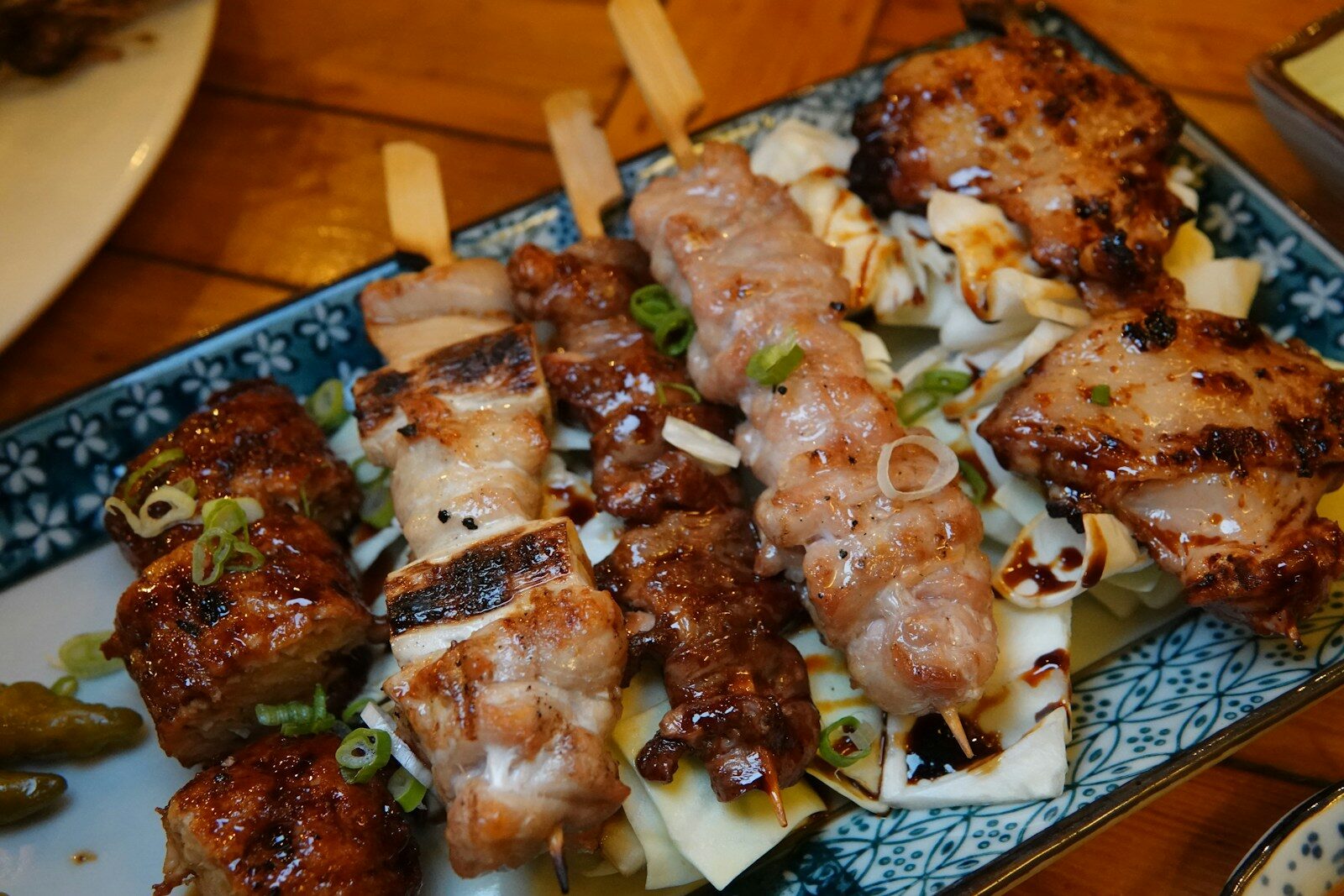
Yakitori — grilled chicken skewers, every part of the bird, kissed with either salt or a sweet-savoury tare glaze.
Taiyaki — a fish-shaped cake filled with sweet red bean paste, custard, or chocolate. The perfect walking snack.
Kushikatsu — Osaka’s deep-fried skewers of meat, veg, and seafood. One golden rule at the counters: no double-dipping in the communal sauce.
And keep an eye out for yaki imo (roasted sweet potato, often sold from a truck in winter), kakigori (fluffy shaved ice in summer), and karaage (Japanese fried chicken) whenever the craving hits.
As the sun goes down: the night stalls
This is where Japan gets atmospheric. Tokyo’s Omoide Yokocho in Shinjuku — a tangle of tiny lanes also nicknamed “Memory Lane” — is wall-to-wall yakitori joints, each seating maybe six people, smoke curling out into the alley. A few streets over, Golden Gai is more about the drinks, but it’s worth wandering for the sheer character of it.
Near Ueno, Ameyoko is a buzzing street market that runs late, with vendors shouting prices and everything from kebabs to fresh fruit on offer.
But for the full open-air experience, head south to Fukuoka. The city is famous for its yatai — mobile food stalls that set up along the river and around Tenjin and Nakasu each evening. You perch on a stool, elbow to elbow with locals, and order Hakata-style tonkotsu ramen with its rich, milky pork broth. There’s nothing quite like it anywhere else in Japan.
Don’t skip the festival stalls
If you’re lucky enough to land during a matsuri (a local festival), you’ll find rows of temporary stalls selling yakisoba, choco-covered bananas, candied apples, and karaage by the bagful. The food is simple and the mood is everything.
A few quick tips
Carry cash — many stalls still don’t take cards. It’s normal to eat standing right where you bought your food rather than walking and eating. And if a queue of locals has formed, join it; they know something you don’t.
Street food in Japan rewards the curious. Point at what looks good, hand over your coins, and dig in.