
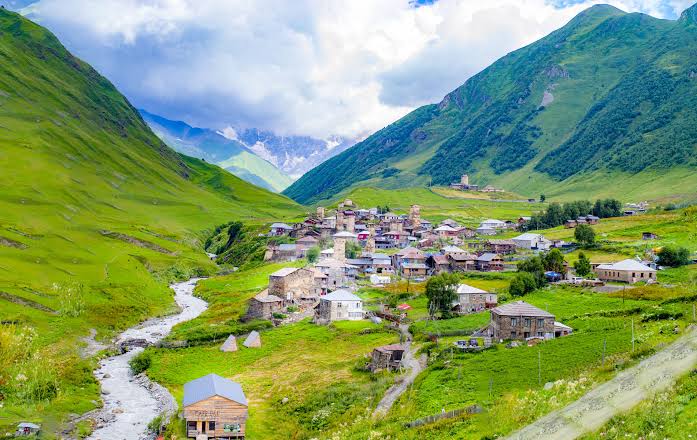
Svaneti – Georgia’s Tower-Studded Corner of the Caucasus
There are places that feel genuinely far away, and then there’s Svaneti. Tucked into the high northwest of Georgia, where the Greater Caucasus rears up into a wall of snow and rock, this is a region that has spent most of its long history being difficult to reach — and is all the better for it.
You feel it the moment the road climbs into the gorges. The valleys narrow, the peaks sharpen, and then, scattered across the green hillsides like something out of a half-remembered legend, the towers appear.
The towers
Svaneti’s signature image is the koshki — slender medieval stone defensive towers that cluster in the mountain villages, often two or three to a single family home. Most date back roughly 800 to 1,000 years, built when this was lawless, hard country and a family needed somewhere to retreat when raiders, avalanches or a neighbouring clan came calling. Blood feuds were a real and ongoing fact of life here, and the towers were as much about surviving your neighbours as repelling outsiders.
What makes them extraordinary is that they’re still standing, still woven into living villages. This isn’t a ruin you photograph from behind a rope. People hang their washing between centuries-old fortifications.
Ushguli, near the top of Europe
Push to the very head of the Enguri valley and you reach Ushguli, a cluster of four hamlets sitting at around 2,100 metres. It’s frequently described as one of the highest continuously inhabited settlements in Europe — and standing there, with the great white pyramid of Mount Shkhara (Georgia’s highest peak, over 5,000 metres) filling the head of the valley, the claim is easy to believe.
The upper village of Chazhashi is part of the UNESCO World Heritage listing for Upper Svaneti, and wandering its lanes — cobbles, towers, woodsmoke, the occasional cow with right of way — feels less like sightseeing and more like stepping sideways out of your own century.
A people, and a language, of their own
The Svans have lived in these mountains for thousands of years, and their isolation bred something rare: their own language. Svan is related to Georgian but is its own tongue, unwritten and unintelligible to most Georgians, kept alive almost entirely by being spoken. It’s a quiet reminder that you’re not just in a remote part of Georgia — you’re somewhere with a distinct identity all its own.
That identity shows up on the plate, too. Look out for kubdari, the Svan answer to khachapuri — a rich, peppery bread stuffed with spiced meat rather than cheese — and Svan salt, an aromatic blend of herbs and garlic that locals put on everything. You’ll want to take some home.
The hiking
This is the real reason a lot of people make the journey. Svaneti is serious walking country, and the trails deliver views that more famous European ranges would charge a fortune to access.
The classic is the multi-day trek between Mestia, the regional hub, and Ushguli — a few days of high passes, alpine meadows, tower-villages and guesthouse hospitality, with the twin horns of Mount Ushba haunting the horizon. There are shorter options too: the day walk up to the Chalaadi Glacier or the Koruldi Lakes above Mestia will give you the scale of the place without committing to a full expedition.
And the crowds? Still blessedly thin. Mestia has grown busier and more set up for visitors in recent years, but step onto the trails or out to the smaller villages and you’ll often have the mountains largely to yourself — the kind of solitude that’s getting genuinely hard to find in the Alps or the Dolomites.
Knowing before you go
Svaneti rewards a bit of planning. The hiking season runs roughly June to September; outside that, snow can close the roads and many guesthouses shut. Getting in usually means flying into Tbilisi or Kutaisi and then a long, scenic drive (or shared marshrutka) up to Mestia — there are also small seasonal flights into Mestia if you’d rather skip the road. Mountain weather does what it likes, so pack layers whatever the forecast says.
It takes effort to get here. That’s exactly the point. Svaneti is for travellers who’d rather earn their views than queue for them — and who don’t mind that the most memorable thing about a place might be a thousand-year-old tower with a cat asleep on the doorstep.


